
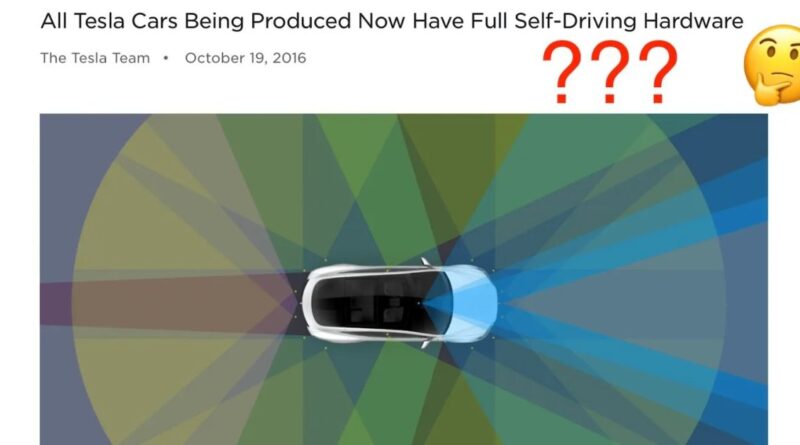
Tesla changes ‘all cars have self-driving hardware’ wording as HW3 lawsuits emerge
Tesla no longer promises that all of its cars will have fully autonomous driving hardware on board, instead now saying that its cars are “designed for autonomy.”
The change comes amid growing calls for Tesla to upgrade older cars, sold with the promise of fully autonomous operation but whose hardware is increasingly unable to run the latest versions of Tesla’s driver assistance software.
We’re going into a little history because in late 2016, Tesla confidently stated on its website that “All Tesla cars now in production have fully self-driving hardware.”
The idea was that even if Tesla software he wasn’t quite up to snuff yet hardware on Tesla vehicles, he was capable of fully self-driving tasks, with a set of cameras and a brain powerful enough to theoretically be able to drive the car by itself, without human intervention.
And since Tesla vehicles rely heavily on software updates, those who spent the thousands of dollars required to purchase access to Tesla’s Full Self-Driving software (which still doesn’t fully drive itself to this day) would eventually get the full autonomous driving capability that will be given to them over the air without having to bring the car in for service and add any computer sensors.
This blog post was written during Tesla’s “hardware 2” or HW2 system. It was Tesla’s first hardware platform, as the previous HW1 was produced in collaboration with Mobileye.
Eventually, the HW2 proved to be underpowered, so Tesla began offering free computer upgrades to its newer HW3 computer to those who purchased Full Self-Driving (FSD). People who didn’t buy FSD wouldn’t get the upgrade, but that’s okay because they wouldn’t need it anyway (well, except for people who buy FSD subscriptions, who were charged $1000 by Tesla for the hardware they already bought, and still continue to charge this fee even though you sold these cars with the promise that they included all the hardware necessary for FSD).
That was all well and good… until Tesla introduced the next version of its self-driving hardware (HW4, sometimes called AI4), with other update (HW5/AI5) planned for release soon.
It’s becoming obvious that the HW3 just doesn’t have the computing power it needs, and Tesla knows it. The company knows it will need to upgrade the computers in potentially hundreds of thousands of vehicles before they can fully perform self-driving tasks, but instead of offering a solution, it keeps kicking the can.
Instead, some of Tesla’s solutions have been to simply change the language it uses. Tesla has repeatedly backtracked on autonomy-related promises, either by deleting a blog post where it promised FSD hardware, starting to call FSD “FSD (Supervised)” and adjusting how it defines FSD.
Tesla now says its cars are ‘designed for autonomy’
And today, another step has been taken, with Tesla now stating that all of its cars are “designed for autonomy,” notably not promising that they will include any hardware features that would make this possible.
In Tesla’s Q3 shareholder letter released today, the company includes this line (emphasis ours):
Our focus remains on scaling our core hardware business by maximizing our delivery and deployment, as these products will deliver increasing value to our customers over time through AI-powered services. *Every Tesla vehicle delivered today is designed for autonomy* while each Tesla energy storage product can be improved and optimized with our virtual power plant or Autobidder feature.
The difference is small but important. Previously, Tesla promised that these cars they already have hardware for full self-driving, and then created an entire blog post detailing exactly what that means.
Now the company only says they were designed with autonomy in mind, but it doesn’t come with any specific features that would make it possible for today’s customers in the future. This formulation promises less, while making it sound like an autonomous future is coming. It allows Tesla to sell the solution later, but doesn’t tell current buyers they’re getting anything yet — or anytime soon.
This is no small feature change, it’s the core of Tesla’s marketing
And that promise of autonomous driving has been central to Tesla’s business over the years. Over the past decade, Tesla CEO Elon Musk has repeatedly stated that full autonomous driving capabilities will arrive soon — usually by “the end of this year” or “the end of next year” in any given year.
Musk said Tesla as a company has “basically zero value” if it doesn’t address full autonomous driving. He recently said that self-driving and Robotaxis would be worth around $5 trillion to the company.
He also said that cars will “asset appreciate” thanks to FSD, so if you bought a Tesla in the past, it would be worth more today, due to the increasing value of self-driving software and the ability to use your car to do useful work for you (pick up the kids, buy groceries, or run your own personal Robotaxi service… something we haven’t heard of charging more money for its half – even though Tesla does drive “robotaxis”).
Legal challenges could cost Tesla a lot
The language change is also relevant to various legal disputes over Tesla’s treatment of HW3 customers.
For years, every Tesla sold was sold with the promise of full self-driving capability, and many customers spent up to $15,000 to access software that hadn’t yet been delivered.
At least three class-action lawsuits are now pending in the US, China and Australia over Tesla’s failure to deliver on its autonomy promises. Together, these lawsuits and other potential challenges could mean trillions of dollars in liabilities for the company.
And so Tesla needed to change its language to something more casual. He may try to argue that cars delivered after these language changes should not be eligible for free updates. Perhaps he’s hoping that by the time real autonomy arrives, enough HW2 cars will have aged off the road so there won’t be many left to replace the computers.
Or it might just be kicking the can without a plan because its CEO is too busy doing ketamine and pretending to be good at video games while trying to destroy his own company.
The 30% federal solar tax credit ends this year. If you’ve ever thought about going solar, now is the time to act. To make sure you find a trusted and reliable solar installer in your area who offers competitive prices, check out EnergySagea free service that makes it easy for you to use solar energy. It has hundreds of pre-screened solar installers competing for your business, ensuring you get a high quality solution and save 20-30% compared to doing it yourself. Plus, it’s free to use and you won’t receive sales calls until you choose an installer and give them your phone number.
Your personalized solar quotes can be easily compared online and you get access to unbiased energy advisors to help you every step of the way. Start here.


FTC: We use automatic income earning affiliate links. More.