

We have built too many EV battery factories. Here’s What Happens Next
- A new report says that capacity to produce batteries for electric cars far outstrips global demand.
- It’s worst in China, but the overcapacity problem exists in every major market and represents a financial risk for battery manufacturers.
- Material and manufacturing costs are still high, meaning that electric vehicles are often no cheaper than gas cars, reducing demand.
The world of electric vehicles has a new problem: too many batteries.
Battery manufacturing capacity for electric vehicles is outstripping demand for the batteries in every major market, according to a new report from consulting group AlixPartners. In North America, there is 1.9 times more capacity than demand. In Europe, the capacity to demand ratio is 2.2.
And China, there’s an absolutely stunning glut of capacity: 5.6 times more battery building capacity than battery demand. With tariffs also restricting electric vehicles and components from the country’s main markets, it’s time to be weak on China’s battery suppliers. But frankly, it’s not like things have gotten any better in the rest of the world, as AlixPartners senior vice president Rohit Gujarathi explained to me.
“On a global scale, five times demand versus three times demand is not really that different. No matter where you go at the moment, capacity is still way behind what demand is,” Gujarathi said in an interview. Because while North American capacity looks better on paper, it’s lacking in some ways. For example, there is very little local production of lithium-iron-phosphate batteries, which offer lower cost and better lifetime at the expense of density.
But there is little incentive to build new capacity right now because existing plants are already being overbuilt for current demand, the report said. There are specific issues that have caused overcapacity in specific markets: high incentive spending in China, self-incentives for electric cars in the US, and aggressive regulation by the European Union. But overall, the key factor was that consumers simply didn’t respond to the increase in electric options the way automakers, experts and regulators expected.
Gujarathi says the main reason they haven’t done so is cost.
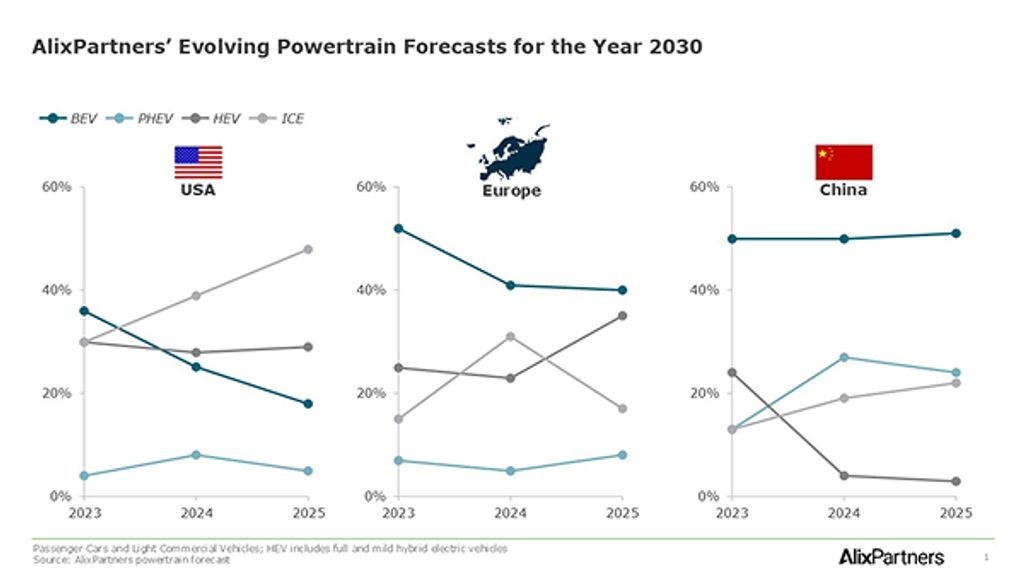
Graph of predicted demand for types of vehicle power units.
Photo credit: InsideEVs
“What consumers care about is, ‘What’s the price of the vehicle?'” he said.
“Does it make economic sense to me? The point of view now in most cases is no, especially since a lot of government support has been taken away,” he added. Despite abundant supply pushing prices down, EV battery manufacturing costs and material costs remain high, and companies can’t sell them for less than what they cost to make in the long run. This instability is already putting financial pressure on battery companies.
This comes as the US has now eliminated its federal tax credit and scrapped emissions standards that forced carmakers to offer zero-emissions vehicles. The result is likely to be a contraction in the EV market, but no one can say how much of a decline we’ll see. The numbers weren’t great last month, but they also reflect that many consumers bought early to take advantage of the tax break before it expires on September 30.
Regardless, the shrinking market won’t help the capacity-to-demand ratio. AlixPartners expects it to grow to 2.4 by 2028 and remain at that level until 2030. This reflects the firm’s earlier 2030 North America revision. Last year, it predicted that 36% of new car buyers in the US would buy electric cars by 2030. This year, it revised that number down by 58%.
The result is likely to be further consolidation of existing battery factories and efforts, including deals like the one in which General Motors sold its stake in a battery factory it once shared with LG Energy Solution. Gujarathi said he also expects companies to start LFP battery factories in the U.S. to address the cost issue.
This follows, as we already know, GM putting North American LFP batteries into the new Chevy Bolt. However, overall demand for these low-cost EVs remains unproven, so expect companies to remain nimble. We’ve seen some companies try to satisfy plans to make batteries for electric cars to make things like energy storage systems instead. But regardless of how exactly companies manage the oversupply, the uncertainty of today’s market is sure to affect the future of affordable EVs.
“What this means is holding back some of the investments that may happen in the future,” Gujarathi said. Companies must prepare to change technologies, battery chemistries and model plans as the situation evolves.
“Everybody’s holding a pattern now because the ground is shifting underneath them,” he said. It may be like this for some time to come.
Contact the author: Mack.Hogan@insideevs.com