
Why the inequality makes us ev, solar and heat pumps fragile – cleantechnica
Support for Cleantechnica support through signature or lane signature.
The title number is surprising. Top 10% of US households now represent about half of all consumer expenditure, according to the data specified in Wall Street Journal and Bloomberg In 2025. This has never been true in the modern era. It creates a situation where the economic pulse we take from consumers is not a long reflection of the wide population, but a reflection of how self -confidence and liquid are rich. When wealthy households constantly spend on cars, travel and upgrading housing, the numbers indicate resistance. In fact, most households are stretched and Rettenching, with a small influence on aggregated data. The economy was at the top of the supreme for the wealth of a small group.
The gap between the diameter and the median captures distortion. The census data show that the actual middle household income in 2024 was $ 83,730. The average remains significantly higher, reflecting the tension of the highest income. Wealth tells a sharper story. The census in 2022 showed the middle wealth of households for $ 176,500, while distribution financial accounts of the Federal Reserve placed an average of approximately $ 1.06 million. The TOP 10% controls about 67% of all US wealth, while the lower half holds only 2.5-3%. Bombers can buy new cars, solar fields and highly effective HVAC without thinking about return. Everyone else delays, rents or goes.
Electric vehicles are a clear example of how inequality shape adoption. Kelley Blue’s data show that the average transaction prices of new cars were approximately $ 49,000 in the middle of 2025, while the average for EV was around $ 56.900. This will completely locate most of the medium -revenue households from the new automotive market. Even with the Federal Tax Credit $ 7,500, according to Section 30D in the Internal Revenue Code Code, it means that only some models are qualified and many buyers are excluded by tools or price prices. The market is dominated by tributary buyers. The tariffs to imported or shifts of competence are unoor oriented. They buy Teslas, Rivians and Lucid Sedans because they can. Politicians and analysts can look at these sales and declare success, but the basic truth is that the acceptance of EV is very chamfered. Research from the Center for Research has shown the middle production of households buying EVs, which spent $ 150,000, far beyond the national median. If stock markets hit, it could fall tributaries and the sale of EV would decrease sharply.
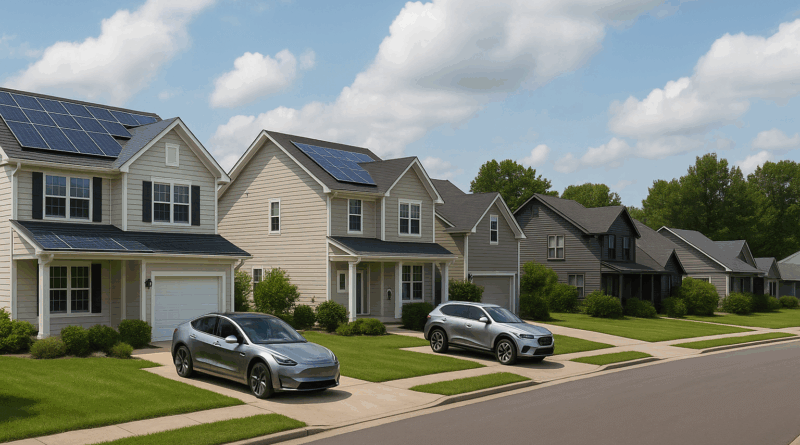
Residential solar energy is monitored by a similar formula. Ownership of the house, access to the loan and initial capital are in line with high inability. Lawrence Berkeley National Laboratory found that most of the new roof solar systems were installed by households in the first two quintillas. Federal incentives structured as tax loans strengthen that Skew Becuse only households with considerable tax severity can fully claim them. Internal income services instructions still provide 30% of the residential solar tax credit by 2032, but tenants and low -income owners remain able to use. Meanwhile, regulators in several countries reduce export rates for solar households. California’s net billing tariff, implemented in 2023, Sharly reduced the value of exports and Arizona previously moved to a similar structure. Aggregated installation numbers are climbing on, but they rise to the roofs of the rich. This promotes political will, because non -acid households consider politics to be a substitute for their richer neighbors.
The heat pumps necessary for the decarbonization of the heat of the building are also concentrated among the rich. The installed costs of whole grain equipment usually run from $ 16,000 to $ 20,000, while some projects take over $ 25,000 depending on the size of the house and the climate, according to the industry assembled by America and consumer reports. Even with the incentive, these households remain out of reach. The federal tax credit 25C allows up to $ 2,000 per year for heat pumps and discounts at the state level level under the High Electric Domestic Square Act are introduced throughout the country.
Richer homeowners are constantly adoptive, motivated by efficiency, comfort and climate values. Their adoption creates a growth curve that looks strong on paper. But the fact is that most American houses continue to rely on fossil heating. Without wider access through targeted subsidies, rental programs or cheap financing, heat pumps will remain a niche for those who can afford initial expenses.
A large beautiful income account and inequality weighs the tax relief to rich households and at the same time take back credits that promote the acceptance of pure energy for the middle class. High earnings have the most benefit from permanent cuts, widespread through deductions and higher exemptions from real estate tax, which increase their ability to accumulate wealth and pass them on to future generations. At the same time, early ending of credits for EV, residential solar and heat pumps removes important costs for household costs with stricter budgets.
The result is a fiscal policy that increases the arrangement of the TOP 10% and at the same time increases key technologies for all others. Over time, this combination intensifies the concentration of wealth, accelerates divergence between average and medium results, and leaves the transition of pure energy more and more depends on buyers.
This creates fragility. When EV, roof solar and heat pumps are transmitted by the highest 10%, the transition looks more robust than it is. The creators of politicians who still manage the transition, the state level, now that the federal government has stopped responsibility again, see data on adoption that are misleading. The market looks healthy until the inflow break, and then it is not. The robobal transition is vulnerable to a financial decline and politically vulnerable because it excludes most of the population. This way you do not build a resistant transformation of the energy system.
History shows what happens when wealth disappears without control. The Roman late Republic dominated the elites with huge property and hated themselves cooked into populism, assassinations and civil wars. France before 1789 had nobles and clergy isolated from taxation, while the burden fell on citizens and the French revolution swept the system away. The gilded age of the United States focused wealth in the hands of several industrial barons and reactions was the progressive era, antitrust actions and income taxes. Interwar Europe has seen a combination of authoritarian policy of inequality and depression. Over time and geography, extreme inequality was either correctly reform or torn.
Today, the United States is at the highest level of inequality since the 20th century. Income gaps are wide, wealth gaps are wider and mobile across classes are low and these weaknesses are destroying and decreasing. This combination is corrosive. Trust in the Falls institution, polarization deepens and roots. The transition of an energy transition based on the adoption of flies risk that it becomes politically toxic. If EV, solar and heat pumps are marked as toys for rich subsidies and politicians that support them, they will face the opposition, even in blue states. Decarbonization stops. In order to be sustainable, the middle and lower deciles must participate, not only rich.
Inequality does not hold forever. Requires clearing and reforming or breaking companies. In connection with the climate, the time is short. The transition must be fair, if it succeeds. Politics that expand the approach, Reteers’ Revance, reduce in advance and provide real savings to the majority, are not just socially fair. They are essential for building durable, politically sustainable and permanent economies of pure energy. If the transition remains on the custom of expenditure at the top 10, it will always be endangered.
Sign up for a weekly Restack Cleantechnica for Zach and Scott’s depth analysis and high -level summons, register for our daily newsletter and watch us in Google News!
Do you have a tip for CLEANTECHNICA? Want to advertise? Do you want to design a guest for our Podcast CLEANTTECH TALK? Contact us here.
Sign up for our daily rapporteur for 15 new clearing stories a day. Or sign up for our weekly on the best stories of the week if it is too common daily.
https://www.youtube.com/watch?v=hpcams8vwnc
Cleantechnica uses affiliate links. Take a look at our policy here.
Cleantechnica is how policy
(Tagstotranslate) California